A lot of media attention has been given to the failure of Christians to pass on their faith to the next generation. The statistics are alarming. And yet the church has probably never made children a greater priority or had better programs for them.
Clearly, church programs are not the problem. The flip side of this is that church programs are not the solution.
This video by Kurt Bruner shows a beautiful analogy of God's model for faith development:
There is no greater influence on the development of a child's faith than
the influence of their parents. In fact, the research shows that
parents are 2-3 times more influential than even the best of youth
ministry programs. It's time for us to get back to the basics--back to God's design for passing on the faith.
Saturday, January 21, 2012


Friday, December 30, 2011
What Is "Ministry" Anyway? - Part 2 of 2
 |
| Photo: Microsoft Images |
If we seek to glorify God, we must do so by using the gifts He has given us to minister to others. "As each one has received a gift, minister it to one another. If anyone speaks, they should do so as one who speaks the very words of God. If anyone serves, they should do so with the strength God provides, so that in all things God may be praised through Jesus Christ. To him be the glory and the power for ever and ever" (I Peter 4:10-11, NIV, NKJV).
 |
| Photo: AnnettVauteck |
Let's take to heart the admonition given to Archippus, "Take heed to the ministry which you have received in the Lord and fulfill it" (Colossians 4:17). In the end, "each of us will give account of ourselves to God" (Romans 14:12) whether we have fulfilled His will for our lives. Are you ready to do the work that God has created you to do? Will you hear Him say, "Well done, good and faithful servant. You have been faithful over a few things; I will make you ruler over many things" (Matthew 25:21)?
Thursday, December 22, 2011
What Is "Ministry" Anyway? - Part 1 of 2
 |
| Photo: Microsoft Images |
Occasionally on this blog, I will use the term "family ministry." What exactly does "ministry" mean anyway? Often when we hear "ministry," we think about people who have been ordained to office and therefore have authority within the structure of a church organization.
 |
| Photo: Microsoft Images |
Ideally, there is a reciprocal relationship between those of rank and general members to encourage one another so their faith is mutually strengthened. As Paul stated, "I want to encourage you in your faith, but I also want to be encouraged by yours" (Romans 1:11-12). One of the purposes of the church is to "consider one another in order to stir up love and good works" (Hebrews 10:24).
Please stay tuned for Part 2 of "What Is 'Ministry' Anyway?"
Tuesday, December 13, 2011
Movie Nights: A Technique For Teaching Biblical Worldview
How can we equip our children for adulthood? What skills do they need to avoid being deceived and losing their faith? How can we prepare them to recognize subtle spiritual attacks? When Christianity requires that they swim against the tide of the rest of our culture, will they know and be ready to do so?
 |
| Photo: Mitja Ribic |
A fun and effective way to teach Biblical worldview and critical thinking skills involves using movies, the form of media most likely to elicit a strong emotional reaction. Movie Nights are mentioned as a technique in Revolutionary Parenting, a book which reveals extensive research into the common principles and methods used by parents who have raised spiritual champions. Want to know more? I highly, highly, highly recommend this entertaining and informative Movie Night Chats podcast by Kurt Bruner where explains how he has used Movie Nights with his own family. (Did I mention that I highly recommend you listen to the podcast?--Yes, it's that helpful!) Also included are some amusing video clips from interviews with other parents and kids who use Movie Nights.
Benefits of Movie Nights include:
- Stimulating discussion about spiritual matters
- Learning to perceive subtle messages or bias
- Understanding the underlying belief system of writers
- Strengthening Biblical worldview
- Evaluating these influences in the light of eternal truths
The critical thinking skills that it hones can be applied to music, other forms of media, books, news coverage of current events, and lectures given by college professors. Not only will your child gain clarity in their thought processes and reinforce their faith, they will also be learning how to communicate these beliefs to others.
 |
| Photo: Bmaksym |
 and Movie Nights for Teens
 . These books provide the same information as you will find on the Movie Night Chat blog but contain more detail and examine different movies. I particularly appreciate the meticulous focus on "cautions" for each film where they describe anything in the movie that could be potentially scary or offensive. In addition the books provide some follow-up activities and suggestions for making this an effective technique to use with your family.
Movie Nights can create wonderful family memories. Through Movie Nights, you initiate dialogue about topics that are hard to discuss. They can also provide a training ground for skills that will serve your child for years to come. Some families do Movie Nights on their own. Others have group Movie Nights with other families. However you choose to do Movie Nights, have fun!
If you use this technique, please share your experiences. I would love to hear about it!
Oh, and don't forget the popcorn!
 | |
| Photo: Microsoft Images |
Thursday, December 1, 2011
Why Family Is More Effective Than Children's Ministry
As a parent, I'm a little skeptical of these numbers. For parents of school-age children, I'm pretty sure that some of those 3,000 hours are spent sleeping. :) However, the basic principle is still solid. Research confirms that parents are far more influential on their child's faith development than any church program.
But there's more than just numbers and time at work here.
I am a parent--and I am involved in children's ministry. When I am working with a group of children at church, I don't know the personal fears of those children. I don't know what sins they are struggling with. I often don't know who has been fighting with their siblings that week or been disrespectful to their parents. I may not know if they have been the subject of gossip or bullying at school. Frankly, if I did know those things, it wouldn't be very wise to bring it up in a group of their peers.
But in the family, we already know these things about each another. We can talk about them. We can drive home the practical application of Biblical lessons to fit our children's personal lives. We can make it real for them. As a parent, I'm very aware of my child's character weaknesses and can foresee potential stumbling blocks. As a parent, I can tailor our talks about God to specifically what my child needs to grow spiritually. They can receive customized spiritual instruction and coaching in the home in addition to the lessons they are learning at church.

I love youth ministry. There is no question that is extremely valuable and important. My own involvement as a young person left a lasting and powerful impact on my future. Nevertheless, we can't rely on church programs to pass the faith on to our children. That's not the model of passing on the faith that God set forth in the Bible.
Here is a challenge for you! If you can find a scripture that clearly states that the church has the primary responsibility for passing on the faith to the next generation, I would love for you to share it in the comments. I've searched and haven't found it. I have found numerous scriptures that lay this responsibility firmly at the feet of parents. I'll share my favorite here:
He commanded our ancestors
to teach them to their children,
so the next generation might know them—
even the children not yet born—
and they in turn will teach their own children.
So each generation should set its hope anew on God,
not forgetting his glorious miracles
and obeying his commands.
to teach them to their children,
so the next generation might know them—
even the children not yet born—
and they in turn will teach their own children.
So each generation should set its hope anew on God,
not forgetting his glorious miracles
and obeying his commands.
Psalm 78:5-7
So the question becomes, what do our lives reflect? Do our priorities reflect the belief that WE are God's primary tool for impressing the hearts of our children with a love for Him? Do our actions reflect the belief that WE are responsible for planting seeds of faith in our children and nurturing those seeds as they blossom?

Friday, November 11, 2011
A Gift for My Children: Scripture Memorization
I am preparing a gift for my children. One that will have immeasurable worth. One that will serve them for the rest of their lives. It is the gift of scripture memorization.
I have never met a Christian adult who doesn't wish they knew more of the Bible. Did you know that most of the Bible verses or poems an adult can recite were learned by age 10? Memorization is a natural skill for young children, and what they learn tends to stick in long-term memory. It's as though God has given us a window of opportunity for filling our children's minds with His word.
Two tools have been very helpful as we focus on memorizing Bible scriptures.
1. Charlotte Mason Scripture Memory System
 We spend far less time on memory work since we've started using this system, yet the time spent is far more effective. We've made it part of our daily routine. During breakfast, out comes the file box with memory cards. By reviewing consistently each morning, we only spend 5 minutes per day (or less!) and see amazing results. I simply printed out this PDF file to use as dividers for our index cards, though I'm considering adding new dividers for quarterly review for those scriptures that have been mastered. I print out the entire Bible verse on one side of a 3x5 index card and then write the scriptural reference on the other side. Since my son is an independent reader, he has been able to take charge of his Bible memory file box on his own.
2. Scriptures In Song
Ever get a song stuck in your head? As long as we are playing music for our kids, why not add a few albums of Bible scriptures set to music. Some of our favorites are Hide 'em in Your Heart Vol. 1 by Steve Green and
Seeds of Worship. If you like the Seeds of Worship music, there are free printables for them at their website or at Bible Story Printables. Another classic starting point for memorizing Bible verses is using the ABC Bible verses. 26 Alphabet Bible Verse Chorus Songs
by Steve Green and
Seeds of Worship. If you like the Seeds of Worship music, there are free printables for them at their website or at Bible Story Printables. Another classic starting point for memorizing Bible verses is using the ABC Bible verses. 26 Alphabet Bible Verse Chorus Songs are a great companion to the ABC Bible Verse printables at I Can Teach My Child. When we find an album of scriptures in song that we like, I print off cards for each scripture and add them to our Charlotte Mason Scripture Memory System. Covenant Life Church has made free songs of Bible verses available online here so you can get started without spending a dime. This same method can be used when memorizing entire chapters of the Bible by using resources such as those available from Thy Word Creations..
Wanting to use technology to help with the memorization of scripture? Fighter Verses includes apps for the iPhone or Android.
What has helped your children with the memorization of scripture?
I have never met a Christian adult who doesn't wish they knew more of the Bible. Did you know that most of the Bible verses or poems an adult can recite were learned by age 10? Memorization is a natural skill for young children, and what they learn tends to stick in long-term memory. It's as though God has given us a window of opportunity for filling our children's minds with His word.
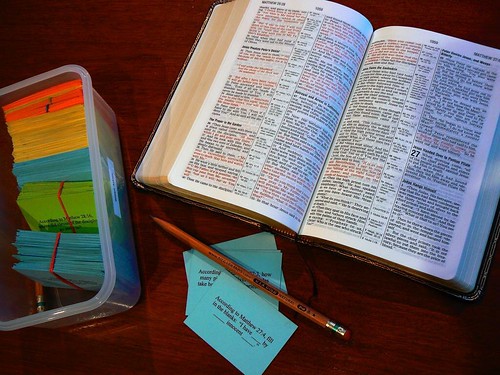 |
| Photo: Vicki Ashton |
Two tools have been very helpful as we focus on memorizing Bible scriptures.
1. Charlotte Mason Scripture Memory System
2. Scriptures In Song
Ever get a song stuck in your head? As long as we are playing music for our kids, why not add a few albums of Bible scriptures set to music. Some of our favorites are Hide 'em in Your Heart Vol. 1
by Steve Green and
Seeds of Worship. If you like the Seeds of Worship music, there are free printables for them at their website or at Bible Story Printables. Another classic starting point for memorizing Bible verses is using the ABC Bible verses. 26 Alphabet Bible Verse Chorus Songs are a great companion to the ABC Bible Verse printables at I Can Teach My Child. When we find an album of scriptures in song that we like, I print off cards for each scripture and add them to our Charlotte Mason Scripture Memory System. Covenant Life Church has made free songs of Bible verses available online here so you can get started without spending a dime. This same method can be used when memorizing entire chapters of the Bible by using resources such as those available from Thy Word Creations..Wanting to use technology to help with the memorization of scripture? Fighter Verses includes apps for the iPhone or Android.
What has helped your children with the memorization of scripture?
 |
| Photo: Christianphotos.net |
Wednesday, November 9, 2011
Breaking Down the Barriers to Family Discipleship
Here are some fast facts for you:

Here are just a few of the many barriers that can prevent us from following the Biblical model of discipling our own children:
This video is less than two minutes long, but it is a powerful motivator for making the spiritual training our children a priority.
Discipling our children on a day-to-day basis requires absolute dedication. This blog is about breaking down some of the barriers to making our homes the place where our children's faith is nurtured. It's about equipping you, encouraging you, and inspiring you in this great endeavor. Feel free to comment or send me an email telling me what would be helpful to see on Turning Our Hearts.
.
- 85% of Christian parents who regularly attend church believe the primary responsibility for teaching their children about the faith rests on their shoulders.
- 10% of church-going families talk with their children about spiritual matters.
- 5% of church-going families participate in any kind of family worship (separate from a corporate worship service).

Here are just a few of the many barriers that can prevent us from following the Biblical model of discipling our own children:
- Shifting of responsibility. In our culture, it is very easy to shift the responsibility for the spiritual training of our children onto the church. Yet God never intended for the church to be primarily responsible for passing the faith on to the next generation.
- Lack of know-how. Most parents--even if they grew up in a Christian home--have not seen family discipleship modeled. We know we need to be doing more for our children's spiritual development than just taking them to church. But we simply don't know what more to do. What does family discipleship look like in everyday life?
- Lack of support. Parenting is not for the faint of heart. When we are discouraged, we need someone to lift us up. When we feel overwhelmed, we need emotional support. And sometimes all we need to stay on track is someone else there telling us that we're doing the right thing.
- Time constraints. Need I say more? This is a huge challenge for families today!
This video is less than two minutes long, but it is a powerful motivator for making the spiritual training our children a priority.
Discipling our children on a day-to-day basis requires absolute dedication. This blog is about breaking down some of the barriers to making our homes the place where our children's faith is nurtured. It's about equipping you, encouraging you, and inspiring you in this great endeavor. Feel free to comment or send me an email telling me what would be helpful to see on Turning Our Hearts.
.
Subscribe to:
Posts (Atom)